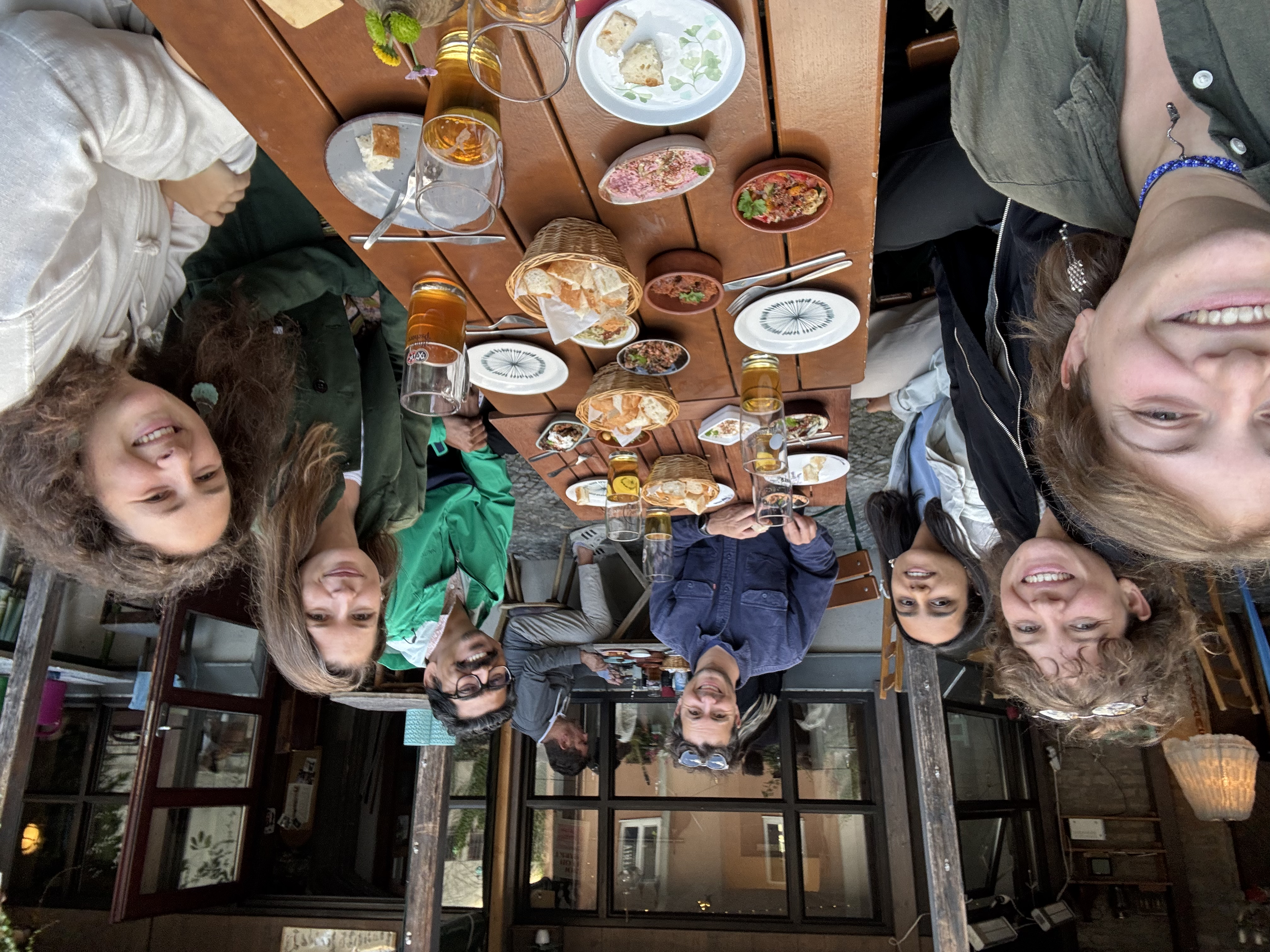
From July 16-18, the S.AND and Off the Menu teams met in Augsburg for the Watery Sand Workshop to explore core research themes – water and sand – through the lens of scale.
Sharing insights on diverse topics - ranging from sand, sediment, and water to cod, oysters, and sea urchins - we spent three days exploring how scale helps us think about materiality and political ecologies. Scale not just served as a tool of measurement, but as something fluid: a social process that allows to relate in certain ways, move along, or resist. We thus came to see scale as a useful line of inquiry - one that opens empirical and theoretical questions about politics, governance, time, and everyday life.
Thinking about scale allowed our conversations to cover vast ground. Tarini Monga and Teresa Cremer related thoughts on sand extraction in Goa and Mombasa, while Lukas Ley shared insights on sediment dredging in Marseille. Javed Kaisar spoke about sedimentary governance on the refugee island Bhasan Char. The OTM team contributed insights on oyster farms and sea urchins, either becoming invasive or extinct, depending on where you stand. Thinking our projects in tandem in fact allowed us to reflect on positionality and perspective - how much of theory is anchored to space and land, and how thinking with water and sand requires shifting the perspective.
Despite working with different objects and methods (the OTM team has a historian bachground), we found interesting overlaps between approaches when tracing how scale shows up in our research. From a single grain of sand to an entire beach, from one drop of water to the vast ocean, from the price of one oyster to the dynamics of extractive economies - to what extent do size and volume matter? How does scale relate to the singular and the plural, the individual and the collective? Do sand, sediments, water, fish, oysters or sea urchins gain or lose value through volume? Put differently, when does an pile of sand become valuable, and when does it become useless? At what scale do our stories matter and when do these stories become even powerful? Thinking with Tsing’s concept of nonscalability, we also wondered when our research objects become part of system that tends to ignore individuality and thinks value exclusively in terms of replicability. What happens if we refuse to scale, to measure, to compare our findings?
Another key conversation focused on extractive economies, turning to big industries and small local practices and how they shape landscapes and livelihoods. We shared ideas about what counts as „large-scale“ or „small-scale“ extraction and critically examined the assumption that “local” equates to ethical or sustainable, and “large-scale” means exploitative. At what scale are practices deemed extractive?
These questions animated our exchange, while sand and water helped ground abstract discussions in sensory detail - inviting us to think through the texture, smell, and sound of scale. Can scale be sensed, heard, felt, and represented – how? Over the workshop days we crafted a beautiful collage of field fragments, images, sketches, poetry, and embroidery, that helped us weave our ideas more closely together.
The collective practice of reading, writing, drawing, discussing, and, of course, eating left us energized and inpired. We left with new ideas, new questions, and lots of fresh literature tipps. A plan fomented to meet again next year in Halle. Until then, we’ll keep asking: scale - so what?
Reading list:
- On Nonscalability: The Living World is Not Amenable to Precision-Nested Scales by Anna L. Tsing (2012) (https://doi.org/10.1215/0961754X-1630424)
- Interscalar Vehicles for an African Anthropocene: On Waste, Temporality, and Violence by Gabrielle Hecht (https://doi.org/10.14506/ca33.1.05)
- The World in a Grain: The Story of Sand and How It Transformed Civilization by Vincent Beiser
- The Planet in a Pebble: A Journey Into Earth’s Deep History by Jan Zalasiewicz
- Wild Blue Media: Thinking Through Seawater by Joe Melody Christina (https://www.dukeupress.edu/wild-blue-media)
- Why Fish Don’t Exist by Lulu Miller
- Eating the Ocean by Elspeth Probyn (https://www.dukeupress.edu/eating-the-ocean)
- We Are All Whalers: The Plight of Whales and Our Responsibility by Michael J. Moore (https://press.uchicago.edu/ucp/books/book/chicago/W/bo113867120.html)
- Sea Level: A History by Wilko Graf von Hardenberg (https://press.uchicago.edu/ucp/books/book/chicago/S/bo221935080.html)
- Anthropogenic Soils by Jeffrey Howard
Film tip:
- Geographies of solitude directed by Jaqueline Mills (2022)